FREE Standard Shipping on Orders Over $75

Racks and Accessories to Organize, Store, and Display Your Boards & Gear

Sunday, June 17, 2012

Surfboard Stands | Store and Display your Surfboard without Drilling into the Wall

You need a place to store your surfboard?  You don't feel like getting out your tools and drilling into your nicely painted walls?  What you need is a surfboard stand!  This type of surf rack makes it easy to both store and display your surfboard.

With the size of a surfboard, it can be a hassle to hoist the board to the wall each night when returning from longs hours spent in the surf.  But StoreYourBoard has another solution: Free Standing Surf Racks.  This particular kind of rack is the perfect if your living space is limited and also leaves your walls screw-free.  Free standing surf racks can also easily be moved when it comes time to board up the beach house or rearrange the furniture.

There are generally two different types of surfboard stands:
(1) Center Fin NOT Required, and
(2) Center Fin Required

Center Fin NOT Required:

Surfboard Stand - Free Standing Surf RackSurf Display Stand

This free standing surf rack does not require a center fin to secure your surfboard.  It is cradled by the rack to allow easy removal and placement.  You can display your surfboard in this rack with or without fins. 


Center Fin Required:


This surfboard stand uses the center fin of your surfboard as a way to secure the board and firmly hold it until your next set. StoreYourBoard’s Center Fin Surfboard Stands feature a padded lip where the base of your board rests while the center fin holds it vertical. Pretty simple rack that does a nice job holding your surfboard.


StoreYourBoard also offers a special free standing rack that holds surfboards both with and without fin, the Surfboard Floor Display Stand.  However, in order for it to hold a surfboard with a center fin, the board needs to be placed in the stand with the fin facing out.  This stand has an adjustable mechanism that squeezes the sides of the board as its weight is applied to the bottom of the stand. As soon as you lift up on the surfboard the sides release and you can easily take your board out.

This rack creates a very nice visual display.  The surf rack is made from high quality wood and would be a great rack to showoff your favorite surfboard in your family room, office, or wo/man cave.

One thing to keep in mind is that these free standing racks have height limitations.  But no worries - we offer surfboard wall racks that are sturdy and allow you to hang longboards and multiple surfboards.  


Wednesday, June 13, 2012

Stand Up Paddle Boarding | It’s Everywhere

A new board sport is hitting the scene and making a name for itself: Stand Up Paddle Boarding.  Though it has been around for a few years, its popularity is rising with the easy accessibility and excellent workout the sport provides.  


A well-rounded sport, stand up paddle boarding allows its rider to stand up paddleboard on lakes, rivers, and oceans—there are no limitations.  The lakes and rivers provide a calmer atmosphere and are better places to paddleboard for a beginner.  However, you don’t have to be an advanced rider to be in the ocean.  The ocean provides a rider with calm waves to coast over, along with swells to transform your paddle boarding experience in to one similar to a surfer’s.


Stand up paddle boarding can be a great way to take in the area as well.  With the rider in a standing position, paddle boarding down the windy rivers offers a great opportunity to tour the area and it’s local spots (and for free too!).


Like most sports, stand up paddle boarding is an awesome cardio workout.  It tones the rider’s arms, core, legs and butt as they try to stay balanced while paddling through the water.  It is an all over body toning workout that, surprisingly, doesn’t leave the rider sore the next day.  Though it may seem difficult to pick up, stand up paddle boarding is actually a sport that most people believe anyone can do.  


So if you’re planning your next vacation and want to stay active, try looking to rent a stand up paddleboard to learn the area.  If you’re an experienced rider, check out StoreYourBoard.com and take look at our SUP Racks to show off your board.

Ride On,
       Colleen 

Sunday, June 10, 2012

Famous Surfers | Ride the Wave, Live the Wave


Few people on the planet have the privilege of saying that their office is Mother Nature’s blue ocean.  For these surf pros and legends, the water is another home where they hone their skills to be some of the best surfers in the world.  Take a look to see who made our list:

Laird Hamilton – Never feeling the need to actually compete or turn pro, Laird Hamilton is known as the best at big wave surfing.  Born March 2, 1964 Hamilton referred to surfing as a work of art rather than a way to win cash and trophies.  While out on the water in 1992 with fellow big wave riders Darrick Doerner and Buzzy Kerbox, the group created tow-in surfing as a way to reach giant waves that would be difficult for a surfer paddling to reach.  Though some surf buffs thought this new creation was cheating and took away from the sport, many accepted it as a necessary way to seize outrageous sized waves.  Hamilton’s adventurous fire burned on in 2000 when he rode one of the “heaviest waves” in Teahupo‘o, Tahiti, a place known for its dangerous coral under layer.  The ride made the cover of 
                                                                                      Surfer Magazine, exposing Laird Hamilton in his element of 
                                                                                      big wave riding.  

Kelly Slater – Born February 11, 1972 Kelly Slater was, and still is, the inspiration for surfers to pick up a surfboard and ride the waves for the first time.  Though he won championships and appeared in surfshorts in the 1980s, Slater started a new revelation in the 1990s when he went pro.  His appearance in Quicksilver’s 30-minute video titled Black and White exposed a new style of surfing that challenged the way of riding a wave and inspired many of the young pro surfers out there today.  His accomplishments include being the youngest and oldest surfer to claim the world title, which he won 11 times, along with 30 other victories spread throughout World Title events and other Tour events.  Still competing 20 years after being officially sponsored, Slater is an icon for surfers everywhere.

Andy Irons – A full-blooded Hawaiian, Andy Irons, born on July 24, 1978, used his backyard to hone his surfing skills along side of his brother Bruce.   His claim to fame came in 1996 at the HIC Pipeline Pro, when he shocked judges and onlookers as he surpassed his competitors on a 12’ Pipeline.   Throughout his pro career, Irons succeeded in winning four Vans Triple Crown Titles and three World Professional Surfing Championships.  His battle with surf rival Kelly Slater was present throughout his surfing career as he came up through the ranks to steal a World Professional Surfing Championship title from the now 11-time winner.  Sadly, the surfer’s life was cut short when he unexpectedly passed away November 2, 2010.  However, his passion for the sport and 
                                                                                      determination while competing will never be forgotten.

Mick Fanning – Nicknamed “White Lightening,” this Aussie native, born June 13, 1981, began surfing at the age of five.  His career launched in 1996 when he won three Australian National Titles.  Going pro in 2002, he won the Rookie of the Year at the Billabong Pro event.  Completely tearing his hamstring in 2004 didn’t stop him from competing and placing in tournaments as soon as his rehabilitation finished.  Then in 2007, Fanning knocked Kelly Slater off the head of the podium when he placed first in the ASP World tour.    He made his presence known when he took the crown for the second time in 2009.

Taj Burrow – Picking up a surfboard at the age of seven, this other Aussie native, born June 2, 1978, didn’t have his rookie year until 1999 when he won the Rookie of the Year title.  Making a name for himself, that same year Burrows was the runner up for the ASP World Tour event.  At the time, he was the youngest to do so at the ripe age of 18.  Landing in the runner up position again in 2007, and 13 other event wins under his belt, this Australian Surfing Hall of Fame inductee is a force to be reckoned with.


Dayne Reynolds – Born September 7, 1985, Dayne Reynolds is a surfer known widely for his “go broke style” of surfing.  Sharpening his skills on local Cali beaches, Reynolds experimented with many aerial maneuvers that helped him win during the 2003 and 2004 X Games.  His attacking of waves head on and time spent in the air while surfing gets him noticed in ASP events, pushing the boundaries of the sport.  However, that aggressiveness is getting him inducted into the Surfer’s Hall of Fame in August 2012.


And now for the soulful shredding ladies…

Layne Beachley – Diving head first into the pro level of surfing, Layne Beachley, born May 24, 1972, was the best of her generation before retiring in 2008.  Ranked #6 in the world at the age of 20, Beachley pushed herself, successfully riding big waves like no other woman.  Her skill and soul of surfing played out as she became the ASP World Tour Champion in 1998 and maintained the title until 2004, only to win it again in 2006.  


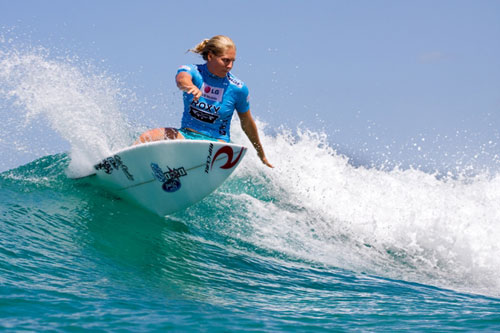
Stephanie Gilmore – Born January 29, 1988, this Gold Coast native entered the surfing scene at the age of 17 when she won the Roxy Pro Gold Coast as a wildcard.  She shocked fellow surfers even more when she won first place in the 2007 ASP World Tour event—her rookie season.  Gilmore went on to the claim the title for three more years, only to lose it to newcomer Carissa Moore in 2011.  Riding waves that can be classified as wimpy to explosive, Stephanie Gilmore is one of surfing’s best.

Sally Fitzgibbons – This young surfer is making a name for herself throughout the ASP.  Born December 19, 1990 she qualified for the ASP World Tour in 2008 faster than most surfers before her did.  A well-rounded athlete (participating in cross-country, touch football, and soccer along with surfing) Fitzgibbons followed the call of the wave winning junior-pro titles one after the other.  Adding pressure to experienced athletes, she placed second two years in a row for the ASP World Title. 


Each of these surfers has the heart and drive to be successful in riding waves.  Determination and drive, while mixing his or her own style to the mix, makes each of these surfers an individual.  Here at StoreYourBoard we keep that in mind with our various surf racks, making sure each is designed to fit your various riding needs.

Ride On,
        Colleen 

Thursday, June 7, 2012

Father’s Day Gifts | StoreYourBoard Display Racks Make the Perfect Gift

Just a reminder that Father’s Day is right around the corner (Sunday June 17th in case you forgot) and for all of the board sport loving dads out there a wall rack would be a great way for them to display their board of choice.   

Not to mention, it may put you in good standing with your mom, too, if she’s tired of his things cluttering the garage! Speaking of garages, StoreYourBoard has racks that not only store boards, but racks that are capable of storing all of dad’s tools/rakes as well.  


Better order now so it arrives on time!

Ride On,
        Colleen

Monday, June 4, 2012

Store Your Board on Twitter | Follow All Your Favorite Board Sports


Did you know…


Follow us at @StoreYourBoard for the latest scoop about not only our racks, but the latest news in board sports and why we love them.

Here’s an awesome shot of a tweet from us that made it to the live stream of the ASP World Tour Event going on in Fiji this week!


Monday, May 21, 2012

Surfboard Carrier | Get to the Waves the Easy Way

Do you surf?  Do you have a surfboard carrier?  The most likely answer is NO.  I know a lot of surfers and I don't think I know of anyone who has a surfboard carrier.  


What is a Surfboard Carrier?

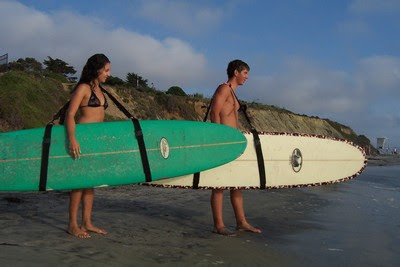
A surfboard carrier is used to make it easier to carry your surfboard to the beach.  A surfboard carrier can take multiple forms but it is a device that helps you get your surfboard to the waves quicker and easier.  The most common form is a strap type like the one seen below.  There are numerous kinds out there that basically all do the same thing.  They are composed of two straps that hook around your surfboard and then they have a shoulder strap that links them together and lets your carry your surfboard over your shoulder. 

Surfboard Carrier

It is a very simple carrier but it does wonders.  If you have anything bigger than a shortboard and you are not a big guy with really long arms I am sure you can appreciate that at times the slug down to the ocean when the wind is blowing, trying to fit your surfboard under your arms or balance it on your head is not the most pleasant.  Not to mention you can't really take anything else to the beach with you.  If you are a pro surfer, I am sure this is not for you, but for the average weekend warrior - we want to spend the say on the beach, hang out, surf a little, etc.  With a surfboard carrier like this you can have your board over your should and your beach chair and cooler in your hands and you are set for a great day at the beach.

Types of Surfboard Carriers:
The most common types of surfboard carriers are the shoulder strap version and the bike rack version.  There are also some newer types that use wheels and a trailer type setup.  Each of these surfboard carriers has its uses.  The Shoulder Strap version is very universal use carrier. At some point you are going to need to take your surfboard from your beach house or car to the ocean to get to the waves.

         Shoulder Strap Surfboard Carrier
SUP Carrier

If you live close to the ocean but not ocean front, a Surfboard Bike Rack Carrier is the perfect solution.  Beach towns are usually great places to bike and why take a car when you can just hop on your bike and cruise down to the beach.  There are different styles of surfboard bike carriers to fit your bike and your surfboard.  Plus riding your bike is the green way to get to your favorite surf spot.

Bike Rack Surfboard Carrier

Surfboard Bike Rack - Carver

The other style surfboard carrier is a trailer style where you attach your surfboard to a frame with wheels.  As seen below you can either attach this to your bike or you can just pull it along behind you.  It is the same idea that families have been using bringing wagons and trailers filled with all their beach stuff for years.  In these surfboard trailers you can hook up your board and all your gear and just roll it down to the beach.

Surfboard Trailer
Surfboard Bike Trailer - Wheels


So make your life a little easier and get a surfboard carrier so you can save your energy for the surfing!


Sorry for the extremely long delay between blog posts.  StoreYourBoard.com has been very busy bringing on new products and working on some exciting new racks and website features.  More to come in future blog posts.  

StoreYourBoard.com Blog

Friday, March 30, 2012

Economical SUP Storage Rack with Paddle Holder

Calling all SUP aficionados I think it is official that the Stand Up Paddleboading craze is starting to take root all over the country.  With spring here and summer fast approaching I know a lot of people dusting off the SUP and ready to get back in the water.  I just wanted to let you know that we now have a great SUP Rack back in stock.


This Stand Up Paddle boarding rack is very economical both on your wallet and space.  Storing your SUP in the upright position really saves spaces and makes it convenient to store your SUP.  This rack also has another great feature, a paddle holder on the front.  This is a feature that some of the racks don't have but is a great thing so you can store your board and paddle together, out of the way and safely in their own rack.


Have one of these SUP Hangers?  Let us know what you think.  Take a picture and send it over to us at info@storeyourboard.com!

Tuesday, March 27, 2012

StoreYourBoard.com Ski and Snowboard Storage Rack Sale


StoreYourBoard Ski and Snowboard Sale
Snowboard Storage Rack
 
 22% Off
 
Buy Now 
 
 
Garage Ski Rack
12% Off
Buy Now


Snowboard Rack
   
 
33% Off 
 

Buy Now
 
Check out these Great Deals or the many other Ski and Snowboard Racks StoreYourBoard.com has to offer.  If you don't ski or snowboard go ahead and use the coupon below on anything site wide includingbike racks, surf racks, SUP racks, and many more.
 
10% Off StoreYourBoard: CODE = Snow 


Saturday, March 17, 2012

Road Bike vs. Mountain Bike: Which to Choose as Your First Bike?

Which to Buy? 

It is a question that I have pondered and a question that always seems to come up when one of my buddies gets into cycling; should I get a road bike or a mountain bike.  Cycling is a great sport in and of itself and it is also a really good cross training activity for many sports.  Quality bikes are not cheap and getting one will required a nice chunk of change.  If money is not a problem the BEST answer is get BOTH!  In then end that happens to many cyclists once they really get the bug and it goes from a mere exercise to a burning passion.


However, if you need to pick one to start here a few things to consider:
  1. What do you want to get out of biking? Are you planning on getting into cycling to explore new things, exercise, ride with friends, or something else?  Consider the real reason you are buying a bike and it should lend itself to one or the other.  For example if the exercise aspect is the most important I would recommend a road bike.  One great thing about a road bike is that you can typically just go out your front door and find a road to ride.  
  2. What do you friends and family currently ride? Cycling is a great social sport, it is often more fun to ride with a group or buddy.  If you friends and family have a mountain bike it is probably a good indication you are going to want a mountain bike as well. 
  3. Where do you live? For your first bike you want something you can get a lot of use out of.  If you live in an area with a lot of trails nearby a mountain bike might be a good fit.  If you live in an area without great trail access a road bike is most likely your best bet.  Keep in mind that if you don't live within biking distance of the trails for your mountain bike you are going to need to transport your bike with some sort of bike car rack.
  4. Amount of time available?  Similar to factoring where you live, factoring in how much time you have to devote to your bike important as well.  If you want to spend a lot of time both are great options and there are many exciting trips you could go over with your bike. If you are limited in time, you are going to want something you can hop on and take out for a spin close to your house.
  5. What does the local bike shop stock the most?  Your local bike shop is going to stock whatever style is most popular in your area.  If they have a lot of mountain bikes in the showroom, you know that it is very popular near you and a good chance there are some great trails to ride.  Another great resource is the people in the bike shop, both employees and customers.  They are going to know of the local events and rides and have a good sense of the local biking scene.


Both a road bike and a mountain bike are great fun so you practically can't go wrong either way.  Enjoy your first bike!  Once you buy your first bike remember StoreYourBoard.com and check out our bike storage racks so you have somewhere to store your bike when you aren't out riding.  As you and your family accumulate more bikes, a bike rack becomes essential.  


What do you suggest? Leave a comment with your thoughts


Tuesday, March 6, 2012

Road Bike vs. Mountain Bike: What are the Differences?


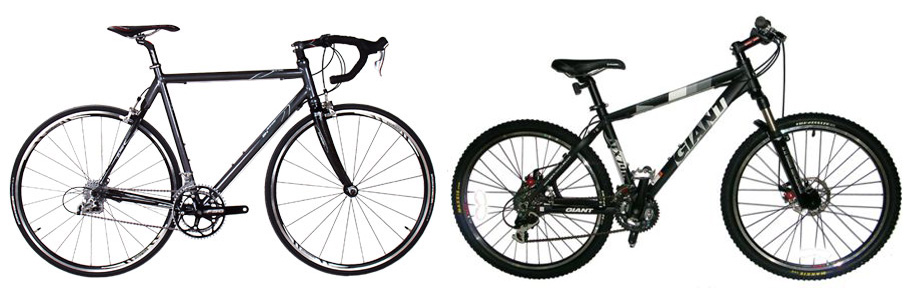
Road Bike vs Mountain Bike


What really makes a road bike a road bike and a mountain bike a mountain bike?  If you are thinking about getting into the sport of cycling and buying a bike you should understand the strengths and weaknesses of each bike.  I will be expanding on this topic in an upcoming post about why to choose a road bike or a mountain bike as your first bike.  Before I get into that I think it is important to learn what makes each bike unique.  This is brief summary where I try to hit some of the basics.  If you want to know more I would suggest you make a trip to your local bike shop.  At the bike shop you will also be able to see the differences in the bikes up close and personal. 

I will also note that the road bike and the mountain bike are two common types of bikes, there are many other kinds of bikes for more specialty usage such as BMX bikes and Triathlon bikes.  There is also a very popular mix of bike that I would refer to as a Hybrid bike.  As the name implies it takes some from the road bike and some from the mountain bike to make a more versatile bike.  If you are out for a leisurely rides this might be the place to start.


Listed below are some key differences  between Road Bike and Mountain Bikes:

  1. Intended Use - Here is the obvious one - Road Bikes are meant for riding on a hard paved surface and mountain bikes are designed for much more rough terrain such as dirt, gravel, and any combination of surfaces.  Either can be ridden on anything but they are not ideally suited.  In general a mountain bike is more versatile because it can be ridden on the road, where as a road bike really can't be ridden in rough terrain (main limitation being it very thin tires).  Although a mountain bike can be ridden on the road, once you ride a road bike on the road you will NOT want to be riding a mountain bike on the road, it feels like you are pedaling a tank down the road compared to a sleek road bike.
  2. Tires - Mountain bikes typically have fatter tires with very nubby tread.  This is to give more traction when you are in the dirt, gravel, and sand.  The wider fatter tires also keep the bike on the surface as opposed to sinking in quickly (think of sand).  Road bikes have very thin tires with a smooth surface.  This is to give the least amount of resistance when you are riding on the road.  Road bike tires are often inflated to very high pressures as well to reduce the rolling resistance.  Think of a race car vs. a monster truck tires.  The race car has "racing slicks" meant for high speeds on dry paved surfaces.  The Monster truck has huge tires with thick treads so it can go anywhere.  Road bikes are built for speed on the road and mountain bikes are built to take you off road through variable conditions.
  3. Rider Position / Geometry - Cycling enthusiasts could go on and on about this topic and all the subtleties but I will try to keep it simple.  Basically a road bike is made to have the rider in an aerodynamic position to reduce the wind resistance and once again increase speed on roads.  To do this the rider is typically meant to be stretched out further over the handlebars and the handle bars themselves have "drops" which go down under the horizontal bar to make the rider even more aerodynamic.  A mountain bike is usually setup to have a more upright position so the rider can better navigate rough terrain.  For many the mountain bike's upright position is much more natural than the bent over aerodynamic road bike position.  There are many different geometries out there for both bikes.  As you get more toward racing bikes the geometries get more "severe" but if you are just getting your first bike you probably won't need a racing bike just yet.
  4. Frame / Shocks - The bike frames on a mountain bike and a road bike are quite different.  Mountain bikes typically have a "beefier" (larger diameter tubing) build to withstand the pounding of off road terrain.  Road bikes on the other hand try to be sleek and aerodynamic.   Another big difference is the shocks/suspension that is typically present on a mountain bike and absent on road bikes.  These shocks are similar to those is your car.  They are used to dampen out the bumps and smooth the ride.  Since a road bike it meant to be ridden on a smooth paved surface there is no need for a a suspension system.  A suspension system would also be detrimental to the power transfer in a road bike.  Road bikes are typically very "stiff" so all the energy you put in through the pedals in transfer into the wheels and propels you ahead.  In a mountain bike, since you are on rough terrain the suspension makes the ride much smoother.
  5. Weight - With both bikes, as you get more high performance bikes they are lighter.  Often time this is accomplished with lighter materials such as carbon fiber.  In general though a road bike will be lighter than a mountain bike.  Reducing weight once again helps with trying to go faster on the road.  As mentioned above, a mountain bike often has a larger frame and heavier components adding to its overall weight.
  6. Components - Components are the different parts of the bike attached to the frame.  These include things like the brakes, shifters, gearing, etc.  All of these are different from road to mountain bike.
    1. Brakes - Typical road bikes have brake calipers that use brake pads on either side of the wheel.  Mountain bikes often time use disk brakes, similar to a car.  In general the disk brakes have more stopping power and stop quicker which is very important on off road terrain.  Road bikes are not really meant to brake quicky so they use a style that is slightly less efficient but lighter.
    2. Handle Bars - Road bikes have "curl" handle bars with a horizontal piece and then the drops that curl down.  These handle bars make a lot of riding positions possible.  Getting in the drops increases your aerodynamic position.  Mountain bike will typically have a wider horizontal handle bar that makes for easier maneuverability in tight spots. 
    3. Gearing - The gears on a bike are what make it comfortable/possible for you to pedal on varying hills and flats.  If you are climbing up a steep hill you want to go to an "easy" gear so you can still pedal although the bike is not moving very fast.  When you are going downhill you want a "harder" gear so you can keep your speed up and pedal without having to spin your legs at 200rpm.  Typically a mountain bike will have more of the "easy" gears that will enable you to ride of very steep grades while as a road bike might not have as "easy" of gear but will have a much larger set of "harder" gears to take advantage of your speed.  Even within road bikes and mountain bikes the gearing will vary widely.  Talk to your bike shop professional about what is best for you.
    4. Shifters -  In order to change those gears you need to have shifters on the handle bars.  On a mountain bike they are typically either a lever or turn style integrated into the horizontal handle bars.  On a road bike the shifters are out in front of the bars and have long  vertical handles so they can be used from multiple positions.  These shifters are also the same levers used to activate the brakes.  Typically you pull back for braking and push the lever to the left or right to shift gears.  On a mountain bike the brake are a separate horizontal lever that activates the brakes.
These are just some of the differences between road bike and mountain bikes.  Hopefully it gives you better insight into why you would use/choose a road bike or a mountain bike.  If you are in the market for a new bike, after you buy your new bike head on over to StoreYourBoard and pickup a bike storage rack for your garage or basement.